
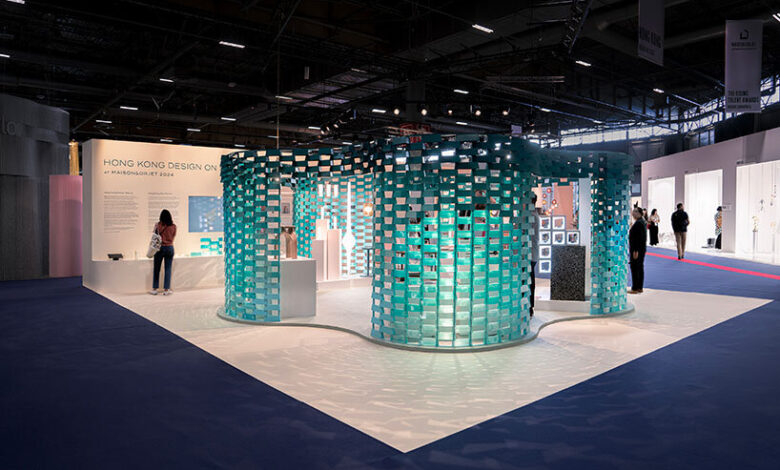
At the 2024 Fall edition of Maison&Objet in Paris, Hong Kong-based architectural firm LAAB unveiled an eco-pavilion constructed from 3D-printed bricks made of recycled water bottles. The Hong Kong Eco-Pavilion features a striking series of turquoise-toned, staggered bricks that create an organic, perforated structure. This innovative pavilion highlights sustainability, material circularity, and a harmonious blend of modern technology with traditional craftsmanship.
During the event, LAAB’s Design Director, Otto Ng, shared insights on the project in a talk moderated by designboom. He explained the process behind transforming discarded plastic bottles into eco-friendly 3D printing filaments and how these filaments were used to create the pavilion’s unique bricks. “In this design, we actually used water bottles collected from ten different secondary schools in Hong Kong,” Ng explained. This process embodies the firm’s commitment to sustainability and its vision of rethinking waste as a valuable resource.

A Fusion of Craftsmanship and Technology
Ng also emphasized the importance of combining traditional craftsmanship with modern digital fabrication techniques. “Craftsmanship is becoming more important. We’re interested in preserving the almost lost craftsmanship from older generations, while also embracing new techniques and digital fabrication,” he said during the talk. This approach highlights the balance between honoring Hong Kong’s cultural heritage and advancing sustainable design through technological innovation.

The eco-pavilion’s 3D-printed bricks, made from recycled PET bottles, were designed to be lightweight, stackable, and portable, minimizing the carbon footprint during transportation. LAAB developed multiple prototypes to ensure the bricks used as little filament as possible while maintaining structural integrity. The pavilion’s design, inspired by Victoria Harbour’s coastline, is configured in a wavy, circular arrangement that reflects Hong Kong’s natural heritage. This ring-shaped design also symbolizes the principles of material circularity, unity, and harmony, which are key elements of Chinese philosophy.
Pigmented in 15 shades of turquoise, the pavilion mirrors the dynamic colors of Victoria Harbour, shifting in appearance depending on the lighting conditions. The staggered arrangement of the eco-bricks allows natural light to filter through, casting shadows reminiscent of harbor waves. The pavilion’s multiple entry points invite visitors to explore from different angles, creating an immersive and interactive experience.

A Pavilion with a Circular Future
One of the most distinctive aspects of the Hong Kong Eco-Pavilion is its focus on reusability. Once the Maison&Objet exhibition concludes, the structure will be disassembled, transported back to Hong Kong, and reassembled for another showcase. Beyond its exhibition life, the 3D-printed eco-bricks can either be repurposed for public structures or reprocessed into filaments for future 3D printing projects. This thoughtful approach reflects LAAB’s mission to redefine waste materials and promote material circularity in architectural design.
By incorporating recycled water bottles into the creation of 3D-printed bricks, LAAB’s pavilion is a model of sustainable design. It demonstrates how innovation can transform waste into valuable resources, creating a positive environmental impact while celebrating Hong Kong’s heritage.
Source: designboom.com